


 Česky (CZK)
 Polski (PLN)
 Deutsch (EUR)
Ford 2.2 TDCi (VDO/Continental) and return circulation
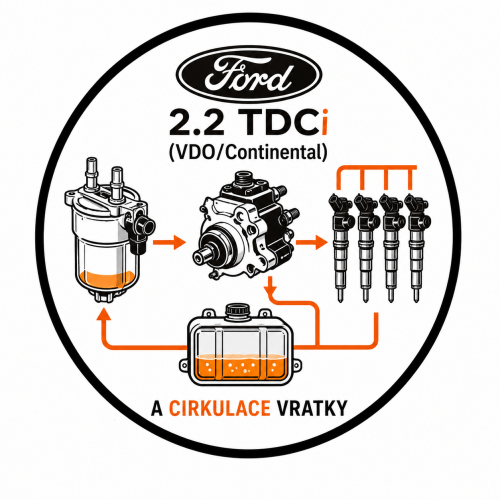
Ford 2.2 TDCi (VDO/Continental) and fuel return circulation: why metal spreads faster in cold weather
What Is the “Temperature Valve in the Filter” and What Does It Do Below 50 °C
In the service documentation for the Duratorq-TDCi (Puma), Ford explains that the fuel filter is equipped with a temperature-controlled fuel return bypass valve to help the fuel warm up more quickly. The principle is simple:
Below 50 °C, the valve is fully open and most of the return fuel circulates through the filter back to the fuel pump.
Above 50 °C, the valve closes and the return fuel is sent back to the tank to prevent the fuel from overheating.
Practical effect in winter: anything present in the return fuel (metal microparticles, fine sludge) tends to circulate more within the small loop (filter ↔ pump) before it is diluted in the tank.
Why Metal Can Spread Faster in Cold Conditions
When the source of metal contamination is in the high-pressure section (HP pump / control elements / injectors), some of the contamination enters the return flow. In the below 50 °C mode, the return fuel does not go straight back to the tank, but repeatedly passes through the filter and back to the pump.
This has two effects:
-
Fast recirculation = contamination reaches other parts of the low-pressure section more quickly.
-
The filter becomes a “collector of evidence” – in winter, you will often see metal in the filter sooner and in greater quantity than would correspond to “normal” flow back to the tank.
How This Affects Findings in the Filter vs. in the Rail (and Why It Can Be Misleading)
The key point is this: “metal in the filter” in these Ford systems during winter does not automatically mean that the source is in the tank or the lift pump. Because of cold return-flow circulation, the filter can be full of metal even when the metal is actually being generated in the high-pressure section.
Simplified interpretation of findings:
-
Metal mainly in the filter + metal also in the rail → strong suspicion of HP contamination (it has already reached sensitive areas).
-
Metal in the filter, but rail clean → this may be an early stage / or the metal may still be getting trapped, but it still applies: without a rail sample, the diagnosis is uncertain.
-
Metal before the filter (from the tank) + metal after the filter → the low-pressure side must also be investigated (tank, module, hoses, filter, leaks).
Practical Winter Diagnostics (Fast and Without Unnecessary Replacements)
Take fuel temperature into account during diagnostics
If you are dealing with metal contamination found after a cold start or in freezing conditions, remember that the return flow may have been circulating through the filter.
Sample mapping (the fastest way to the truth)
-
sample before the filter
-
sample after the filter
-
sample from the rail (where it can be done safely)
This will tell you where the metal appears first, and above all whether the high-pressure section is already contaminated.
Check the filter as a “collector of evidence”
Use a magnet test + visual inspection of the sediment. In winter, take metal found in the filter seriously, but do not treat it as automatic proof of the source.
Be careful with bleeding / running dry
Ford also explicitly warns that the high-pressure pump is lubricated by fuel and must not be turned more than by “manual” rotation if the system is not bled and there is no fuel in the pump – otherwise damage may occur.
DIESELCONTROL tip: in winter, it makes especially good sense to confirm the condition by microscopic testing of fuel from the rail for metal particles — because the filter may look “dirty” simply due to return-flow circulation, and without a rail sample it is easy to draw the wrong conclusion.