

 Česky (CZK)
 Polski (PLN)
 Deutsch (EUR)


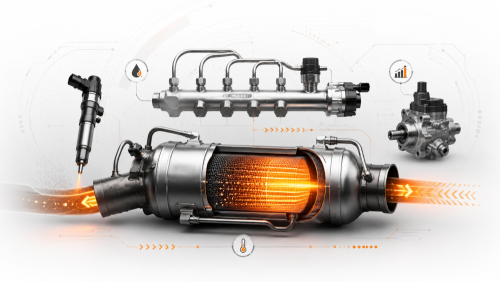
DPF Regeneration and the Fuel System: When the Problem Is Elsewhere
How DPF Regeneration Really Works (and Why It “Consumes” Fuel)
In many diesel engines, the standard strategy for active regeneration is late post-injection: additional injections raise the exhaust temperature so that the soot in the DPF can be burned off. In the technical literature, this is described as the most common approach for achieving the temperature required during active regeneration.
The price for this is higher fuel consumption. Real-world measurements show that active regeneration can increase average route fuel consumption significantly (in one RDE study, by approximately 13% on average during regenerations).
And because regeneration is temperature-controlled, it is essential that the temperature at the DPF inlet is accurately controlled and maintained for a certain period of time.
How Faulty Injectors Damage the DPF (the Most Common Mechanism)
A DPF fills up more quickly the more soot the engine produces. And injectors can significantly increase soot production when:
the spray pattern is incorrect,
the fuel dose is off,
the injector is leaking or dribbling,
or the nozzle geometry/opening is damaged.
Research directly shows that certain types of injector or spray faults can measurably increase soot emissions.
What this means in practice:
faster soot build-up → more frequent regenerations,
more regenerations → more fuel and more heat,
and then further problems follow in the chain (EGR, turbo, oil).
How DPF Problems Can “Kill” the Engine (and Indirectly the Injection System)
1) Backpressure and reduced engine efficiency
As soot builds up in the DPF, flow resistance increases and exhaust backpressure rises, reducing engine performance and efficiency.
This often leads to further regeneration attempts (or incomplete regenerations) → a vicious circle.
2) Oil dilution by diesel during frequent regenerations
Post-injections are effective for heating the exhaust, but part of the fuel can reach the cylinder walls and mix with the engine oil. This mechanism (post-injection → fuel impingement → oil dilution) is described in technical studies.
When regenerations are too frequent or not completed properly, the risk of oil dilution increases — and that then increases engine wear (and indirectly the risks for the whole system).
3) Ash vs. soot: soot can be burned off, ash cannot
Regeneration mainly removes soot. Ash is non-combustible and gradually accumulates in the DPF over time. Technical sources describe that while soot can be removed by regeneration, non-combustible ash gradually builds up in the DPF channels.
In practice: when the DPF is “full of ash”, regeneration will not solve the problem — and the vehicle may start regenerating more and more often, even if the injectors are working properly.
When the Primary Problem Is Fuel / Injection and When It Is the DPF (Quick Distinction)
More likely injection / combustion / fuel related when:
visible smoke, rough running, unstable performance,
strange correction values / poor engine smoothness,
regenerations are frequent again shortly after DPF cleaning or servicing,
the data shows a rapid soot load increase over a short distance,
suspected fuel contamination.
👉 In this case, it makes sense to first address the engine-out issue (why the engine is producing soot) — injectors, fuel pressure, EGR, air system.
More likely DPF related (ash / physical restriction) when:
the engine otherwise runs normally, but Δp (differential pressure) is high,
regeneration does not help or keeps repeating without a clear combustion-related cause,
high mileage and the typical scenario of “soot is OK, but DPF capacity is gone” (ash).
What We Recommend at DIESELCONTROL (Practical Advice)
Do not diagnose the issue based only on a “DPF” warning — the DPF is often the result, not the cause.
When regenerations are frequent, first verify whether the engine is producing excess soot because of injectors or mixture issues (and thereby “killing” the DPF).
If fuel contamination or metal particles are suspected, confirm the condition with a microscopic fuel test from the rail, because otherwise the DPF is often replaced and the problem comes back.