


 Česky (CZK)
 Polski (PLN)
 Deutsch (EUR)
Air ingress into diesel fuel
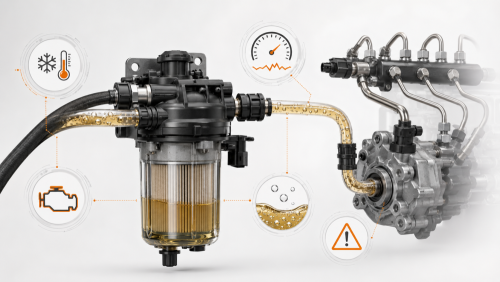
Why a few bubbles can throw off the entire common-rail system
In a modern diesel engine, rail pressure is everything — when the low-pressure side becomes aerated, the high-pressure pump no longer receives a stable fuel supply, and rail pressure builds too slowly or fluctuates. The result: long cranking, hesitation, limp mode, sometimes even stalling.
From a diagnostic point of view, it is important that manufacturers and professional procedures often start by checking the fuel supply itself, including restriction and air ingress, and by measuring vacuum/pressure between the filter and the pump.
Typical symptoms caused by air in diesel fuel
Most commonly, you will see a combination of:
-
longer cranking, especially after the vehicle has been sitting overnight
-
start–stall shortly after starting
-
unstable idle, occasional stumbling
-
power loss under load, sometimes switching into limp mode
-
random pressure-related fault codes (depending on the vehicle, often “rail pressure too low/too slow to build,” etc.)
And this is what makes it tricky: air can trigger faults that look like an injector or pump problem, while the actual cause is “just” a leak on the suction side.
Why nothing may be leaking out, but the system still draws in air
On the suction side (between the tank and the supply/pumping section), there is often vacuum. That means:
-
a leak shows up as air being drawn in,
-
but diesel fuel may not leak out at all (because the system is not pushing it outward).
That is exactly why suction-side leaks are typically hard to find and are often located around the fuel filter and its connections.
Why it may only act up when cold
This matches real-world workshop experience exactly. The most common reasons are:
Material contraction
O-rings and plastic parts become harder / contract when cold → the micro-leak opens up. After warming up, everything “reseals.”
Thicker fuel and higher vacuum
Cold diesel flows worse → the pump has to pull harder → vacuum increases → the leak draws in air more easily. (For supply-side issues, Delphi specifically recommends measuring vacuum/pressure between the filter and the pump.)
Fuel draining back to the tank (drain-back)
Overnight, fuel drains back from part of the line, and in the morning the system first draws in air → long cranking until it fills again.
Where to look first most often (quick checklist map)
From real-world experience, these are usually the top locations:
1) Quick connectors and their O-rings
-
cracked retaining clips, worn sealing surfaces
-
hardened / damaged O-rings
-
micro-cracks in plastic fittings
2) Fuel filter housing
-
hairline cracks (especially on older plastic modules)
-
leaks at threaded fittings / hose connections
-
deformation of the sealing surface
3) Filter lid / cap (and its seal)
-
pinched or old O-ring
-
incorrectly tightened lid (or overtightened → deformation)
-
dirt on the sealing surface after filter replacement
4) Cracked hoses (especially the “soft” rubber sections)
-
micro-cracks, hardening, chafing against a bracket
-
leaks at clamps (typically after previous work)
Note: “Air after filter replacement” is a very common scenario. Delphi directly points out that trapped air and contamination are common causes of problems after installation and shows the correct bleeding procedure.
How to verify it without unnecessary disassembly
1) Transparent hose / visual bubble check
At a suitable point on the low-pressure side (where the design allows it), this is the quickest “aha” test: bubbles = air ingress / aeration.
2) Measuring vacuum/pressure between the filter and the pump
This is the professional approach: if the supply side is restrictive or drawing in air, the readings will show it. Delphi explicitly states that restriction / air leaks should be checked and that vacuum/pressure should be measured between the filter and the pump.
3) Check after the vehicle has been sitting (typically in the morning)
If it only acts up “after a night,” it is often crucial to check the fill state of the line and the behavior during the first start.
Safety: never loosen high-pressure lines / the rail “just for testing.” Common rail is extremely dangerous.
Why it is worth dealing with immediately
Besides annoying starts and fault codes, long-term aeration can mean:
-
higher load on the pumps (they operate under worse conditions),
-
unstable pressure → poorer combustion, smoke, DPF regeneration issues,
-
and most importantly: false diagnostics → unnecessary replacement of expensive parts.
In addition, manufacturers themselves treat “air in the fuel system” as a separate issue with specific checks (for example, a Volvo service bulletin).