

 Česky (CZK)
 Polski (PLN)
 Deutsch (EUR)


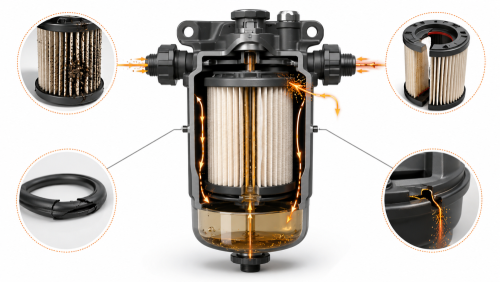
The filter is not an “impenetrable wall”
In an ideal setup, the sequence is: supply pump → fuel filter → high-pressure pump → rail → injectors. In practice, however, the fuel system works as a dynamic circuit where flow, pressure, temperature, and fuel cleanliness can all change. And in exactly these situations, metal particles can sometimes make it past the filter.
1) The particles are extremely fine (micro-particles)
Wear in an electric supply pump often does not produce obvious “shavings,” but microscopic metallic wear debris. Such particles may be right at the limit of that filter’s filtration capability.
A filter has a certain efficiency for a certain particle size, but capture is rarely an absolute 100%.
Even the small percentage that gets through can accumulate over long driving periods and eventually show up in sensitive areas (control components, rail, injectors).
What this means in practice: metal found “after the filter” does not automatically mean the filter is bad — the wear particles may simply be too fine.
2) A bypass opens when filter restriction is high (only in some commercial vehicles)
Daimler / Mercedes-Benz trucks (Actros, Arocs – 10.7 l): MANN+HUMMEL describes a fuel filter module for these trucks with integrated valves and protective functions (including an overpressure valve and other functions within the module). This is a typical “truck” architecture, where valves are used to control flow and protect the system.
Daimler MDEG / Detroit Diesel (DD5, DD8): MANN+HUMMEL states that Daimler uses their compact module for these engines; the module includes a range of integrated functions (pre-filter, recirculation/heating, service valve, etc.).
Note: in truck/module-based solutions, you more often encounter a combination of recirculation, relief/protection valves, and, in some heads/pre-filters, also a bypass valve — the reason is to maintain fuel supply to the engine even in extreme conditions.
In many systems, there is protection against fuel starvation: when the filter is clogged or the fuel becomes thick (for example in winter), a bypass valve may open to prevent the engine from stalling.
At that point, part of the fuel either:
-
bypasses the filter media completely,
-
or passes through the filter by the “shortest route,” with significantly lower filtration efficiency.
Typical bypass triggers:
-
a filter that has not been replaced for a long time,
-
diesel waxing / gelling in freezing temperatures,
-
water in the system (which makes winter problems worse),
-
a clogged pickup strainer / pre-filter that worsens fuel supply and increases pressure differences.
3) Fuel bypasses the filter media because of a leak or installation error
A filter only works when the “dirty” side and the “clean” side are properly separated. It only takes a small issue for fuel to find a path around the media:
-
a damaged or incorrectly seated O-ring,
-
seal deformation,
-
a crack in the plastic filter housing,
-
an incorrectly tightened / incorrectly assembled filter,
-
a poor-quality or incorrect filter for that system.
The result: the filter “looks replaced,” but part of the fuel is actually bypassing it.
4) Deformation of the filter element at a large pressure drop
When the filter is heavily clogged and the system is still trying to push fuel through, this can lead to:
-
pleat deformation,
-
channeling,
-
local rupture or a reduction in the effective filtration area.
This does not necessarily mean the filter will split open visibly. Filtration can simply become less effective, allowing particles to pass through more easily.
5) The system design is not always just “pump → filter → the rest” (unexpected branches and recirculation)
In some cars, the low-pressure side is more complex: the tank module may contain a pre-filter, valves, pulsation dampers, and various branches. In some cases, fuel also recirculates within the modules. That is why it sometimes happens that:
-
part of the contamination can enter branches that are not as straightforward as the diagram suggests,
-
and the contamination then shows up further downstream in the system.
The key point: without mapping the contamination based on the specific vehicle, it is easy to reach the wrong conclusion.
How to tell whether the problem is in the filter or in the source of contamination
The fastest and most reliable way is to compare findings from several locations:
Recommended procedure (diagnostic “map”)
-
Sample before the filter (low-pressure side / supply)
-
Sample after the filter
-
Sample from the rail (if the design allows it)
-
Filter inspection: dirty side, seals, seating, signs of deformation
Interpretation (simplified):
-
metal mainly before the filter → suspicion of the supply pump / tank / suction side,
-
metal clearly after the filter → bypass, filter media bypass, or extremely fine particles,
-
metal mainly in the rail → the higher-pressure part of the system must also be checked (and the extent must not be underestimated).
What we can do about this at DIESELCONTROL
At DIESELCONTROL, we carry out microscopic fuel testing from the rail to check for metal.
This is critical because:
-
microscopic particles are often not visible to the naked eye,
-
and the rail / high-pressure side quickly shows whether contamination has already reached the sensitive components.
This allows us to determine more precisely whether the low-pressure side (supply pump / module / tank) should be addressed first, or whether the system requires a broader intervention.
Summary
Metal shavings from the supply pump can get past the filter mainly when they are microscopically fine, when a bypass opens due to restriction, when fuel bypasses the filter media because of sealing / installation issues, or when the filter loses efficiency due to deformation. Proper diagnostics depend on comparing samples from before the filter, after the filter, and from the rail — which is exactly why a microscopic fuel test from the rail makes sense.